This is a resource material that has been developed to encourage participation in practice.
It is a compilation of animation techniques, icebreakers and games that can be used by anyone who is working with a group of people, either in a workshop, in a training group, in a meeting or in the community.
Teachers must use games for several different reasons, including to help children to know each other, increasing energy levels and enthusiasm, encouraging the development of co-operation or children think about a particular problem.
The games that help children to know each other and help to relax are called icebreakers.
When they look sleepy or tired, animation techniques can be used to get them moving and to give them more enthusiasm (stirrers).
Other games can be used to help children think about problems and can help solve problems that people may face when they work together.
Games can also help children to think creatively and laterally.
Although this is a material developed for adult groups, most of the games can be easily adapted to primary or secondary levels.
Saturday, 20 October 2012
Thursday, 18 October 2012
The Contribution of Multilingualism to Creativity
The Contribution of Multilingualism to Creativity: "Creativity and innovation have been a key focus of attention around the globe in recent years. This is partly due to the need to develop hu...
“The major future challenges in the educational field are how to reform our learning systems to prepare our young people for jobs that do not exist yet, using technologies that have not been invented yet, in order to solve problems that haven’t been identified yet.” (Jan Figel 2009).
Read more at Cockroaches and Ladybugs blog.
“The major future challenges in the educational field are how to reform our learning systems to prepare our young people for jobs that do not exist yet, using technologies that have not been invented yet, in order to solve problems that haven’t been identified yet.” (Jan Figel 2009).
Read more at Cockroaches and Ladybugs blog.
Monday, 15 October 2012
Re-Thinking Project Based Learning
Project Based Learning (PBL) is not a question of "on or off", do PBL or not do PBL... It can mean different things to different people. There are a lot of variations (like in any other educational methodology) and any teacher can construct their own version just by adding or changing some parametres.
Peter Skillen suggest to consider some parametres and to study many of the great resources that are available to you and then create your own working definition and effective PBL practice. (You can find some of these resources below.)
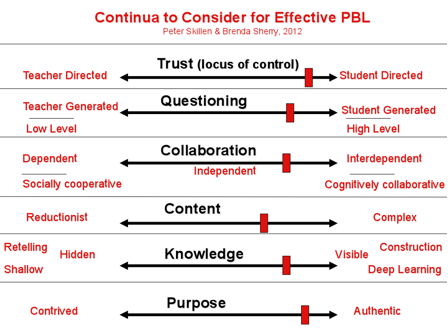
The following diagram, enhanced by the critical eye of Brenda Sherry, can help you figure out what’s important to you and your students, just by sliding from one side to the other the level of each parametre to be considered in your PBL practice.
You could likely add other dimensions to consider (for instance, time management) as you build your own understandings and beliefs!
Trust
Who is in control? Who is initiating the project? Whose passion is being honoured with the project? Who is setting the goals, timelines, and motivation? Are you scaffolding the students’ success through templates, calendars, checklists, rubrics or are you unwittingly stealing their locus of control and micromanaging them. Been there. Done that! Thought I was helping them by giving them lots of assistance!
Questioning
Who is asking the question to be investigated in the project? The student or the teacher? Is the question a ‘deep, driving question’? Is it a ‘fat’ question or a ‘skinny’ one?
Collaboration
If the projects are collaborative in nature, you may wish to consider the amount of interdependence that students have with one another. Are they merely gluing their parts together to make a whole or do their conversations and co-creations lead to a whole that is greater than the sum of its parts?
Content
Is the content a rich, deep problem space or is it a more narrowly focused content area? Are there natural links to other domains that provide a context or is the content deconstructed to remove seemingly distracting and disparate information?
Knowledge
Are the students involved in constructing new meanings and understandings or are they simply retelling in their own words information they have found during their research? Have you built in mechanisms (blogs, wiki, vokis, public journal writing, etc.) so that student thinking is made visible, transparent and discussable or is most student process hidden and unavailable to others?
Purpose
How authentic is the problem under investigation? Are students ‘being’ scientists, historians or geographers and so on, or are they ‘studying’ science, history and geography? How much is the project based in the real world of the student? Is it purposeful for them?
Great Resources for Project Based Learning
- Brenda’s excellent Tech2Learn wiki has a Project-Based Learning page which we developed for some workshops. It includes resources from the best of the best:
- Jane Krauss and Suzie Boss – Reinventing Project-based Learning
- Edutopia
- Buck Institute for Education
- Linda Darling-Hammond – Powerful Learning
- Learning Zone and The Construction Zone blogs.
Chart: Effective PBL Continua by Peter Skillen & Brenda Sherry is licensed under a Creative Commons Attribution-NonCommercial-ShareAlike 3.0 Unported License.
This post originally appeared on Jul 13, 2012 in Voices from the Learning Revolution, by Peter Skillen
Thursday, 20 September 2012
Waiting games for fast finishers, classroom password, breaking the ice, or... whatever you may find them useful for!
Cockroaches and Ladybugs: Waiting games for fast finishers, classroom passwo...:
I have found this list of "20 (Almost) Effortless Waiting Games For Your Kids" in a curious web site called More Than Mommies. The idea to make this list came out when you are with your kids "stuck waiting and patience is growing thin".
Labels:
Activity,
Cooperation,
ESL,
Games,
Interaction,
Warm up
Monday, 10 September 2012
Just few ideas for using digital photography in the ESL classroom
Cockroaches and Ladybugs: Just few ideas for using digital photography in th...: There are many possibilities of using digital photography in the ESL classroom: as prompts for writing or speaking, as a way to tell daily s...
Wednesday, 5 September 2012
eltpics: Photographs collected by teachers for teachers
Cockroaches and Ladybugs: Photographs collected by teachers for teachers: eltpics is a free photographic resource, allocated in Flickr , for teachers, created by teachers. All photographs are creative commons, so i...
Tuesday, 28 August 2012
Ice breakers, knowing each other and five minutes Activities for Interaction
Back to work, back to reality!
Ready to start back?
There is nothing most intimidating for teachers that coping with a large group of children who you don't know at the begining of school year. And this can be very scary for the children, too!
Getting students to feel at ease in a new classroom usually takes a bit of time and work. English language teachers are always looking for "good communicative ice breakers" that breaks this initial "ice", between us and the children.
We need ice breakers to reduce tension in a particular group, to help children to get to know know each other's names (and you to get to know them, too), to involve them into oral language production, to facilitate conversations between individuals, to allow interaction in the groupand to encourage friendships.
I have listed some good ice-breaker activities and games web sites, and other materials I use with my students.
Find them in Cockroaches and Ladybugs: Ice breakers, knowing each other and five minutes activities for Interaction
Explore by yourself!
Subscribe to:
Posts (Atom)