Showing posts with label CLIL. Show all posts

Sunday, 9 March 2014

Teaching Maths Through English or English Through Maths: A CLIL approach

Cockroaches and Ladybugs: Teaching Maths Through English or English Through ...:


Are you thinking in doing some CLIL (Content and Language Integrated Learning) next year? Is Maths your favourite subject to do it but the staff of your school thinks that this is a too tough for to be taught in English? Need some good reasons to convince parents and teachers? Or, are you not sure about some "language" issues when teaching maths...?

Here you are some good "references" may help you!

Tuesday, 28 January 2014

Mind Mapping for Helping Natural Language: Tools

I have been fascinated with mind mapping since I first read  Tony Buzan's   book on this topic many years ago.  


This is a strategy that helps students quickly relate a central word or concept. The mind forms associations almost instantaneously and 'mapping' allows them to write their ideas quicker, using only words or phrases.


Read more about at Cockroaches and Ladybugs: Mind Mapping for Helping Natural Language

Monday, 14 October 2013

Is that CLIL or what?

I have received some comments and questions about what’s CLIL and what’s not and, especially about the definition of "language showers"...  it seems to me that this is an aspect not clearn enough!

Is teaching a subject in a foreign language CLIL? Are immersion programmesCLIL? Are “language showers” CLIL? Are “workshops” or modulesCLIL?
Have a look at the following article and decide by yourself if you are doing CLIL or not!

Monday, 30 September 2013

Web 2.0 tools... How to choose the right one?


Start working with Web 2.0 tools in the classroom can be a hard and painful process that can lead to throw in the towel, before getting some...


How to build our “Web 2.0 Tool Kit”? You won't want to teach a lesson with a technology part if you don't feel confident using technology.

Cockroaches and Ladybugs: Web 2.0 tools... How to choose the right one?:

Wednesday, 26 June 2013

6+1 Action Tips for Project Working

Cockroaches and Ladybugs: 6+1 Action Tips for Project Working:

I remember many years ago, my students turned our English classroom into a TV studio. In groups they decided the different TV programmes they wanted to perform: the weather forecast, News, some advertisements, an interview, and a cooking programme. Then, they did all of the research, decided what information was important to share, wrote the scripts, and practiced after school.


They decided together how to decorate the classroom and how to set the furniture. They invited a TV professional camera to videotape the “performances”. And after that, they showed to the younger in the school and to parents. The video was also viewed in a local TV.

The students still mention it to me when I see them. They are in college now.


Project based learning is learning in its truest form!

Wednesday, 12 June 2013

Why CLIL?

Cockroaches and Ladybugs: Why CLIL?:

If your school is planning to start a CLIL project next school year or you are trying to find reasons to convince your school staff to....

‘Our educational systems were conceived and designed in the intellectual culture of the Enlightenment and the economic circumstances of the Industrial Revolution...’ (Sir Ken Robinson) So if we do not use wigs, if we do not ride horses as the main mean of transport and if we do not use candles to allow us to see things; why do we have to use so old educational systems?'

Wednesday, 15 May 2013

Wednesday, 8 May 2013

How to develop CBLT units


Cockroaches and Ladybugs: How to develop CBLT units:

According to the theory of language learning, " CBLT is based on function and interaction of language, what means that language is taught taking into account the social context and the communicative needs of students".

When talking about the objectives and the syllabus that are going to be implemented in a course, CBLT focuses on competencies.

Wednesday, 1 May 2013

Doing More than Teaching English Language

Teachers of English as a second language to young children must impart English skills at the same time that they foster socialization; heighten an awareness of the self, the immediate classroom community, and the community beyond the school; introduce content concepts; and expose students to art, drama, literature, and music.     


Monday, 15 April 2013

Do you Understand the Size of the Universe?

Cockroaches and Ladybugs: Do you Understand the Size of the Universe?

Several weeks ago, I was surfing the net looking for some resources to explain the size of the Universe. This is a really tough topic, specially when the learners are above 10 and you need some "interactive help" to answer this difficult question in English as a Second Language!

Tuesday, 30 October 2012

Oxfam's Cool Planet


Brought to the group by Antonio, this is the web site he proposed as a resource for designing projects in which children are involved not only in learning English but also in learning values.


Oxfam's Cool Planet is a website that teaches children about some of Oxfam's recipient countries, including food from around the world, children's stories from around the world, and the "Mapping Our World" teaching product.

It is designed to support educators everywhere in the world along with their students and make it as simple as possible for teachers to bring the global dimension into their classrooms.

Using the concept of "global citizenship", it aims to assist teachers in bringing the global dimension into their classrooms. The resources are designed to inform and empower young people to work for a more just, secure and sustainable world.

Many of the resources are organised by theme:
  • Recipies from around the world. Get cooking with some fabulous Fair Trade recipes.
  • Food. What do you think about when you go shopping? The look? A fair deal on the price? What about the people who produce the things you buy… should they get a fair deal too?
  • Mapping our World. This is Oxfam's free interactive whiteboard resource forteaching about maps, perspectives, and geography.
  • Milking. It is an interactive resource about small farmers and international trade designed to facilitate teaching 13- to 16-year-olds about fair trade.
  • Take action. Here are some ideas about how children can work with Oxfam to change the world. There are some really simple things they can do to help, or they can get together with their friends and plan something BIG! Whatever they want to do – it all helps to make the world a fairer and better place.
  • Around the world. Oxfam works in over 70 countries around the world. A guide about few of the countries it works in.
  • Children’s stories. Explore the lives of children from different countries around the world through our exciting photo stories!
  • What is Oxfam. Oxfam's aim, examples of Oxfam’s work, campaigns, and things we can do.
I think Cool Planet kidsweb is a very valuable resource, and we can get some very interesting ideas to develop projects in which Content, Communication, Cognition and Culture are all of them under the umbrella of Social Values.  

http://www.oxfam.org.uk/coolplanet/kidsweb/

Thursday, 18 October 2012

The Contribution of Multilingualism to Creativity

The Contribution of Multilingualism to Creativity: "Creativity and innovation have been a key focus of attention around the globe in recent years. This is partly due to the need to develop hu...


“The major future challenges in the educational field are how to reform our learning systems to prepare our young people for jobs that do not exist yet, using technologies that have not been invented yet, in order to solve problems that haven’t been identified yet.” (Jan Figel 2009).

Read more at Cockroaches and Ladybugs blog.

Monday, 15 October 2012

Re-Thinking Project Based Learning


Project Based Learning (PBL) is not a question of "on or off", do PBL or not do PBL... It can mean different things to different people. There are a lot of variations (like in any other educational methodology) and any teacher can construct their own version just by adding or changing some parametres.

Peter Skillen suggest to consider some parametres and to study many of the great resources that are available to you and then create your own working definition and effective PBL practice. (You can find some of these resources below.)

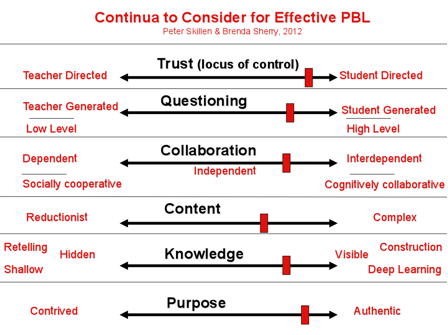
The following diagram, enhanced by the critical eye of Brenda Sherry, can help you figure out what’s important to you and your students, just by sliding from one side to the other the level of each parametre to be considered in your PBL practice.


You could likely add other dimensions to consider (for instance, time management)  as you build your own understandings and beliefs!

Trust
Who is in control? Who is initiating the project? Whose passion is being honoured with the project? Who is setting the goals, timelines, and motivation? Are you scaffolding the students’ success through templates, calendars, checklists, rubrics or are you unwittingly stealing their locus of control and micromanaging them. Been there. Done that! Thought I was helping them by giving them lots of assistance!

Questioning
Who is asking the question to be investigated in the project? The student or the teacher? Is the question a ‘deep, driving question’? Is it a ‘fat’ question or a ‘skinny’ one?

Collaboration
If the projects are collaborative in nature, you may wish to consider the amount of interdependence that students have with one another. Are they merely gluing their parts together to make a whole or do their conversations and co-creations lead to a whole that is greater than the sum of its parts?

Content
Is the content a rich, deep problem space or is it a more narrowly focused content area? Are there natural links to other domains that provide a context or is the content deconstructed to remove seemingly distracting and disparate information?

Knowledge
Are the students involved in constructing new meanings and understandings or are they simply retelling in their own words information they have found during their research? Have you built in mechanisms (blogs, wiki, vokis, public journal writing, etc.) so that student thinking is made visible, transparent and discussable or is most student process hidden and unavailable to others?

Purpose
How authentic is the problem under investigation? Are students ‘being’ scientists, historians or geographers and so on, or are they ‘studying’ science, history and geography? How much is the project based in the real world of the student? Is it purposeful for them?

Great Resources for Project Based Learning


Chart: Effective PBL Continua by Peter Skillen & Brenda Sherry is licensed under a Creative Commons Attribution-NonCommercial-ShareAlike 3.0 Unported License.

This post originally appeared on Jul 13, 2012 in Voices from the Learning Revolution, by Peter Skillen