Showing posts with label Cooperation. Show all posts

Monday, 28 April 2014

Lateral Thinking Stories for the ESL Class

Cockroaches and Ladybugs: Lateral Thinking Stories for the ESL Class: What is lateral thinking?  In 1973 Edward De Bono developed the term “ Lateral Thinking ”. Lateral thinking involves looking at a situati...


In ESL, Lateral Thinking Puzzles are a great resource for thinking, speaking and writing because they are often strange situations which require an explanation.

Saturday, 14 September 2013

Thinking Global, Being Global


"By introducing children early on to concepts of globalization, we stand a greater chance of the next generation utilizing technology and creativity to create a healthier and happier world"

Have you ever visited the pyramids? Do you like sushi? Can you say “hello” in Swahili? Discover what it means to be global in this sweet and lighthearted book and iPad app.

Cockroaches and Ladybugs: Thinking Global, Being Global:

Wednesday, 26 June 2013

6+1 Action Tips for Project Working

Cockroaches and Ladybugs: 6+1 Action Tips for Project Working:

I remember many years ago, my students turned our English classroom into a TV studio. In groups they decided the different TV programmes they wanted to perform: the weather forecast, News, some advertisements, an interview, and a cooking programme. Then, they did all of the research, decided what information was important to share, wrote the scripts, and practiced after school.


They decided together how to decorate the classroom and how to set the furniture. They invited a TV professional camera to videotape the “performances”. And after that, they showed to the younger in the school and to parents. The video was also viewed in a local TV.

The students still mention it to me when I see them. They are in college now.


Project based learning is learning in its truest form!

Thursday, 20 June 2013

My City, Project Based Learning or Content Based Learning in the ESL class

One of the most important topics in the Primary Social Science Curriculum at Cicle Mitjà and Cicle Superior is the city, the town or the village where the students live.

The city landscape of Vitebsk
Knowing the city is a way to know many aspects of the social, cultural and civic around us. But it is also a way to know about museums, interesting places, monuments, history, famous people, unique buildings and curiosities of the town.

In this project, students will conduct a research on one or more aspects of their city (or another one, if we consider it more appropriate). The main aim is to develop a graphic support with varied information to orally show in front of the class and to make a display in the school corridors.


These are just some examples of outputs produced within the project. Power Points and scaled models are probably the most used resources among primary students, but they also used Prezi, Glogster or Issuu.


And this is the complete Unit Plan.


If you want to know something else about this project, the proposal, the basic skills it covers, or to download a Rubric for the assessment of communication, a peer assessment or a self assessment grid, please visit ARC (Aplicació de Recursos al Currículum). The project is fully published in this link: My City.

This project has been developed by TLEinC. ICE UAB Teacher trainers group work, 2013. Authors: Núria Biosca Perich, Enric Calvet Tomàs, Ana M. Esteban Nieto, M. Emília Masdeu Chimeno, Manuela Moledo Nores, M. Carmen Pérez Martin, Antonio Orihuela Lechuga.

Wednesday, 12 June 2013

Why CLIL?

Cockroaches and Ladybugs: Why CLIL?:

If your school is planning to start a CLIL project next school year or you are trying to find reasons to convince your school staff to....

‘Our educational systems were conceived and designed in the intellectual culture of the Enlightenment and the economic circumstances of the Industrial Revolution...’ (Sir Ken Robinson) So if we do not use wigs, if we do not ride horses as the main mean of transport and if we do not use candles to allow us to see things; why do we have to use so old educational systems?'

Wednesday, 15 May 2013

Monday, 18 March 2013

Wednesday, 6 March 2013

When I grow up, I want to be...

Talking about the future and the jobs students plan to do, it is always very rewarding. Children like to imagine how things will be like in their lives and, what’s more, you as a teacher can learn a lot about the personality of your pupils.

In my year 4 Primary ESL class we were involved during three sessions in practicing some research, reading, talking and writing to do a final display on the window corridor about future jobs

This is the way we did in our class, and it was a complete success.


As main objectives I planned:
  • Students will practice their writing skills by writing about what they want to be when they grow up.
  • Students will learn about their profession of choice by researching it.
  • Students will read, choose and write positive comments for their mates and their future jobs
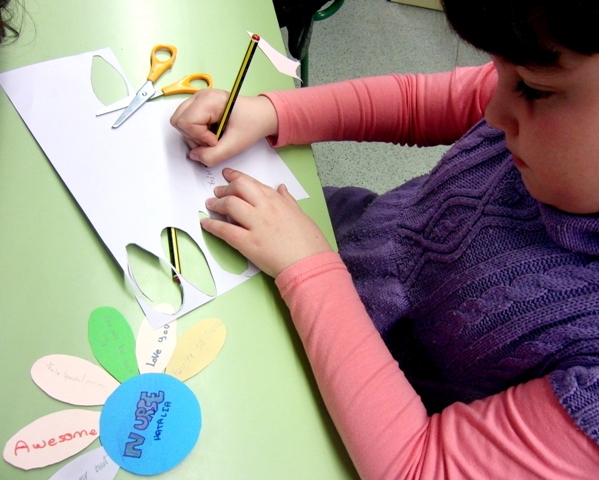
  • Students will practice small motor skills by making a flower for a big display of what they want to be when they grow up.
Materials Needed:
  • The corridor wall or a window for the display
  • Coloured Papers Pencils
  • Crayons/Markers
  • Glue (or other ways to attach finished products to the window)
  • Posters, books or Internet finding on various professions
  • 100 ways to praise a child poster

You can start by leading a group discussion on different jobs…have the students discuss things like what jobs their parents have and what they think they want to be when they grow up.

Show the students the blank space where the project will be displayed. Explain that they are going to fill it up with their writings and pictures (or flowers with a positive comment in each petal).

Invite them to write a paragraph on what they want to be when they grow up. For struggling students, you can make the writing assignment shorter; for advanced ones, you can have them write more. They may go to the school library to get a book on that profession or have a research in Internet in order to know some basic characteristics on it. Then, ask students to draw a picture of themselves in their chosen profession.

You can either post on the display their drawing and writing, or the flowers with nice and praising sentences (this was the way we did!).

To do it more challenging:
  • Put all of the writings together in a class book about jobs.
  • Invite other classes to come take a look at our jobs display.
Please share any new ideas or resources on this topic!


Wednesday, 27 February 2013

A cooking workshop in the ESL class

Cockroaches and Ladybugs: A cooking workshop in the ESL class

Carnival is a festival of immense cultural and historical significance:   “There are many advantages in holding a nursery or school carnival ...

You must strongly think on the idea to do some cooking projects in English. They are a great resource of vocabulary and grammar in a rich context, full of motivation, fun and hands on activities.

Sunday, 4 November 2012

Playscripts

This is a list of playscripts. Very useful if you like practising theatre with your pupils. You've got the title of the play in blue, which is a link to the script. Then, in black, you will find information about about the number of characters, the author and if it works any moral value.


Tuesday, 30 October 2012

Oxfam's Cool Planet


Brought to the group by Antonio, this is the web site he proposed as a resource for designing projects in which children are involved not only in learning English but also in learning values.


Oxfam's Cool Planet is a website that teaches children about some of Oxfam's recipient countries, including food from around the world, children's stories from around the world, and the "Mapping Our World" teaching product.

It is designed to support educators everywhere in the world along with their students and make it as simple as possible for teachers to bring the global dimension into their classrooms.

Using the concept of "global citizenship", it aims to assist teachers in bringing the global dimension into their classrooms. The resources are designed to inform and empower young people to work for a more just, secure and sustainable world.

Many of the resources are organised by theme:
  • Recipies from around the world. Get cooking with some fabulous Fair Trade recipes.
  • Food. What do you think about when you go shopping? The look? A fair deal on the price? What about the people who produce the things you buy… should they get a fair deal too?
  • Mapping our World. This is Oxfam's free interactive whiteboard resource forteaching about maps, perspectives, and geography.
  • Milking. It is an interactive resource about small farmers and international trade designed to facilitate teaching 13- to 16-year-olds about fair trade.
  • Take action. Here are some ideas about how children can work with Oxfam to change the world. There are some really simple things they can do to help, or they can get together with their friends and plan something BIG! Whatever they want to do – it all helps to make the world a fairer and better place.
  • Around the world. Oxfam works in over 70 countries around the world. A guide about few of the countries it works in.
  • Children’s stories. Explore the lives of children from different countries around the world through our exciting photo stories!
  • What is Oxfam. Oxfam's aim, examples of Oxfam’s work, campaigns, and things we can do.
I think Cool Planet kidsweb is a very valuable resource, and we can get some very interesting ideas to develop projects in which Content, Communication, Cognition and Culture are all of them under the umbrella of Social Values.  

http://www.oxfam.org.uk/coolplanet/kidsweb/

Saturday, 20 October 2012

100 Formas de Animar Grupos: Juegos para Usar en Talleres, Reuniones y la Comunidad

This is a resource material that has been developed to encourage participation in practice.

It is a compilation of animation techniques, icebreakers and games that can be used by anyone who is working with a group of people, either in a workshop, in a training group, in a meeting or in the community.

Teachers must use games for several different reasons, including to help children to know each other, increasing energy levels and enthusiasm, encouraging the development of co-operation or children think about a particular problem.

The games that help children to know each other and help to relax are called icebreakers.

When they look sleepy or tired, animation techniques can be used to get them moving and to give them more enthusiasm (stirrers).

Other games can be used to help children think about problems and can help solve problems that people may face when they work together.

Games can also help children to think creatively and laterally.

Although this is a material developed for adult groups, most of the games can be easily adapted to primary or secondary levels.

Monday, 15 October 2012

Re-Thinking Project Based Learning


Project Based Learning (PBL) is not a question of "on or off", do PBL or not do PBL... It can mean different things to different people. There are a lot of variations (like in any other educational methodology) and any teacher can construct their own version just by adding or changing some parametres.

Peter Skillen suggest to consider some parametres and to study many of the great resources that are available to you and then create your own working definition and effective PBL practice. (You can find some of these resources below.)

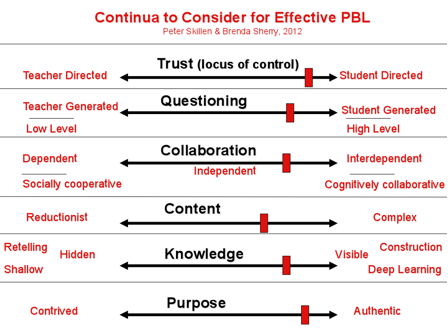
The following diagram, enhanced by the critical eye of Brenda Sherry, can help you figure out what’s important to you and your students, just by sliding from one side to the other the level of each parametre to be considered in your PBL practice.


You could likely add other dimensions to consider (for instance, time management)  as you build your own understandings and beliefs!

Trust
Who is in control? Who is initiating the project? Whose passion is being honoured with the project? Who is setting the goals, timelines, and motivation? Are you scaffolding the students’ success through templates, calendars, checklists, rubrics or are you unwittingly stealing their locus of control and micromanaging them. Been there. Done that! Thought I was helping them by giving them lots of assistance!

Questioning
Who is asking the question to be investigated in the project? The student or the teacher? Is the question a ‘deep, driving question’? Is it a ‘fat’ question or a ‘skinny’ one?

Collaboration
If the projects are collaborative in nature, you may wish to consider the amount of interdependence that students have with one another. Are they merely gluing their parts together to make a whole or do their conversations and co-creations lead to a whole that is greater than the sum of its parts?

Content
Is the content a rich, deep problem space or is it a more narrowly focused content area? Are there natural links to other domains that provide a context or is the content deconstructed to remove seemingly distracting and disparate information?

Knowledge
Are the students involved in constructing new meanings and understandings or are they simply retelling in their own words information they have found during their research? Have you built in mechanisms (blogs, wiki, vokis, public journal writing, etc.) so that student thinking is made visible, transparent and discussable or is most student process hidden and unavailable to others?

Purpose
How authentic is the problem under investigation? Are students ‘being’ scientists, historians or geographers and so on, or are they ‘studying’ science, history and geography? How much is the project based in the real world of the student? Is it purposeful for them?

Great Resources for Project Based Learning


Chart: Effective PBL Continua by Peter Skillen & Brenda Sherry is licensed under a Creative Commons Attribution-NonCommercial-ShareAlike 3.0 Unported License.

This post originally appeared on Jul 13, 2012 in Voices from the Learning Revolution, by Peter Skillen

Thursday, 20 September 2012

Waiting games for fast finishers, classroom password, breaking the ice, or... whatever you may find them useful for!

Cockroaches and Ladybugs: Waiting games for fast finishers, classroom passwo...:

I have found this list of  "20 (Almost) Effortless Waiting Games For Your Kids" in a curious web site called More Than Mommies. The idea to make this list came out when you are with your kids "stuck waiting and patience is growing thin".