Showing posts with label DISPLAY. Show all posts

Friday, 4 April 2014

Teaching English Creatively

Cockroaches and Ladybugs: Teaching English Creatively: 10 creative ways to teach English that deliver outstanding results is an article that Anna Warren published in The Guardian ...


As a ferver defender of project working and open curriculums, I really like the idea of teaching Language through arts: through painting, music composition, a film project, in role drama or sculpture, always having a real purpose in mind. I was happy to find such a clear article like this because some of the approaches are right now in my teaching portfolio.

Tuesday, 25 March 2014

Blended Learning

Cockroaches and Ladybugs: Blended Learning:


“We’re currently preparing students for jobs that don’t yet exist... using technologies that have not been invented... in order to solve problems we don't even know are problems yet". Watch the video and reflect about it!

Tuesday, 28 January 2014

Mind Mapping for Helping Natural Language: Tools

I have been fascinated with mind mapping since I first read  Tony Buzan's   book on this topic many years ago.  


This is a strategy that helps students quickly relate a central word or concept. The mind forms associations almost instantaneously and 'mapping' allows them to write their ideas quicker, using only words or phrases.


Read more about at Cockroaches and Ladybugs: Mind Mapping for Helping Natural Language

Monday, 30 September 2013

Web 2.0 tools... How to choose the right one?


Start working with Web 2.0 tools in the classroom can be a hard and painful process that can lead to throw in the towel, before getting some...


How to build our “Web 2.0 Tool Kit”? You won't want to teach a lesson with a technology part if you don't feel confident using technology.

Cockroaches and Ladybugs: Web 2.0 tools... How to choose the right one?:

Saturday, 7 September 2013

Some Ideas for the ESL class (or for any class!)


Cockroaches and Ladybugs: Some Ideas for the ESL class (or for any class!):

ESL Ideas is a Pinterest Board, compiled by Amanda Avens with lots and lots of resources, tips and ideas for the teaching of English as a Second Language


I will try them in my class this school year, for sure!

Wednesday, 26 June 2013

6+1 Action Tips for Project Working

Cockroaches and Ladybugs: 6+1 Action Tips for Project Working:

I remember many years ago, my students turned our English classroom into a TV studio. In groups they decided the different TV programmes they wanted to perform: the weather forecast, News, some advertisements, an interview, and a cooking programme. Then, they did all of the research, decided what information was important to share, wrote the scripts, and practiced after school.


They decided together how to decorate the classroom and how to set the furniture. They invited a TV professional camera to videotape the “performances”. And after that, they showed to the younger in the school and to parents. The video was also viewed in a local TV.

The students still mention it to me when I see them. They are in college now.


Project based learning is learning in its truest form!

Thursday, 20 June 2013

My City, Project Based Learning or Content Based Learning in the ESL class

One of the most important topics in the Primary Social Science Curriculum at Cicle Mitjà and Cicle Superior is the city, the town or the village where the students live.

The city landscape of Vitebsk
Knowing the city is a way to know many aspects of the social, cultural and civic around us. But it is also a way to know about museums, interesting places, monuments, history, famous people, unique buildings and curiosities of the town.

In this project, students will conduct a research on one or more aspects of their city (or another one, if we consider it more appropriate). The main aim is to develop a graphic support with varied information to orally show in front of the class and to make a display in the school corridors.


These are just some examples of outputs produced within the project. Power Points and scaled models are probably the most used resources among primary students, but they also used Prezi, Glogster or Issuu.


And this is the complete Unit Plan.


If you want to know something else about this project, the proposal, the basic skills it covers, or to download a Rubric for the assessment of communication, a peer assessment or a self assessment grid, please visit ARC (Aplicació de Recursos al Currículum). The project is fully published in this link: My City.

This project has been developed by TLEinC. ICE UAB Teacher trainers group work, 2013. Authors: Núria Biosca Perich, Enric Calvet Tomàs, Ana M. Esteban Nieto, M. Emília Masdeu Chimeno, Manuela Moledo Nores, M. Carmen Pérez Martin, Antonio Orihuela Lechuga.

Wednesday, 8 May 2013

How to develop CBLT units


Cockroaches and Ladybugs: How to develop CBLT units:

According to the theory of language learning, " CBLT is based on function and interaction of language, what means that language is taught taking into account the social context and the communicative needs of students".

When talking about the objectives and the syllabus that are going to be implemented in a course, CBLT focuses on competencies.

Monday, 22 April 2013

Happy Saint George Day!

Cockroaches and Ladybugs: Happy Saint George Day!:

Saint George's Day in Catalonia 


As Saint George is also the Saint Patron of England we benefit of this in the ESL class by talking about castles, legends, knights, kings and princesses, reading books or just listening for fun and enjoyment.

Monday, 15 April 2013

Do you Understand the Size of the Universe?

Cockroaches and Ladybugs: Do you Understand the Size of the Universe?

Several weeks ago, I was surfing the net looking for some resources to explain the size of the Universe. This is a really tough topic, specially when the learners are above 10 and you need some "interactive help" to answer this difficult question in English as a Second Language!

Monday, 18 March 2013

Wednesday, 6 March 2013

When I grow up, I want to be...

Talking about the future and the jobs students plan to do, it is always very rewarding. Children like to imagine how things will be like in their lives and, what’s more, you as a teacher can learn a lot about the personality of your pupils.

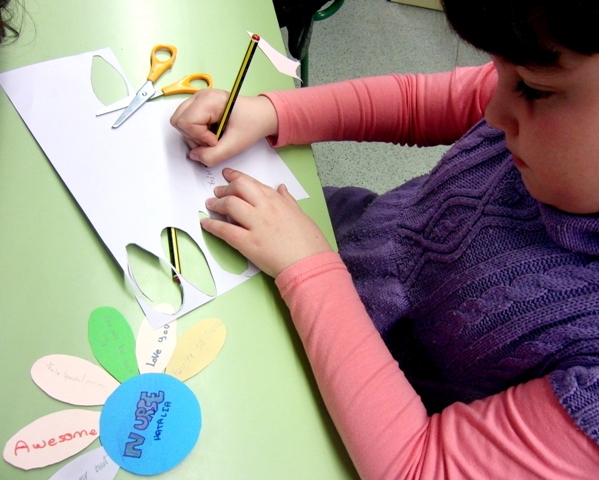
In my year 4 Primary ESL class we were involved during three sessions in practicing some research, reading, talking and writing to do a final display on the window corridor about future jobs

This is the way we did in our class, and it was a complete success.


As main objectives I planned:
  • Students will practice their writing skills by writing about what they want to be when they grow up.
  • Students will learn about their profession of choice by researching it.
  • Students will read, choose and write positive comments for their mates and their future jobs
  • Students will practice small motor skills by making a flower for a big display of what they want to be when they grow up.
Materials Needed:
  • The corridor wall or a window for the display
  • Coloured Papers Pencils
  • Crayons/Markers
  • Glue (or other ways to attach finished products to the window)
  • Posters, books or Internet finding on various professions
  • 100 ways to praise a child poster

You can start by leading a group discussion on different jobs…have the students discuss things like what jobs their parents have and what they think they want to be when they grow up.

Show the students the blank space where the project will be displayed. Explain that they are going to fill it up with their writings and pictures (or flowers with a positive comment in each petal).

Invite them to write a paragraph on what they want to be when they grow up. For struggling students, you can make the writing assignment shorter; for advanced ones, you can have them write more. They may go to the school library to get a book on that profession or have a research in Internet in order to know some basic characteristics on it. Then, ask students to draw a picture of themselves in their chosen profession.

You can either post on the display their drawing and writing, or the flowers with nice and praising sentences (this was the way we did!).

To do it more challenging:
  • Put all of the writings together in a class book about jobs.
  • Invite other classes to come take a look at our jobs display.
Please share any new ideas or resources on this topic!


Monday, 10 December 2012

Foldables and Notebooking

Cockroaches and Ladybugs: Foldables and Notebooking

I’ve been using foldables almost for everything in my English language classes. I work with them vocabulary, grammar, sentences, the four skills, fine motor skills... But the most important thing is that it brings lots of interaction to the class, that it is probably the core of the language skills in Primary ESL.

Tuesday, 4 December 2012

Writing Prompts

Learning English as a Second Language benefit greatly from interactive writing activities . Writing provides ESL students a way to combine their speaking, listening and reading experiences into a creative expression of learning English.

Read more about at Cockroaches and Ladybugs: Writing Prompts

Friday, 16 November 2012

The power of music when Teaching English to Very Young Learners.

How can ELT be made enjoyable and effective in Kindergarten?

Song, a combination of music and lyrics, possesses many intrinsic merits, such as a kaleidoscope of culture, expressiveness, recitability and therapeutic functions, which render it an invaluable source for language teaching.

Read more about at Cockroaches and Ladybugs blog.