Upper Primary Level.
How difficult is to teach conversation in the ESL classroom! How difficult is to stir spontaneous speaking!
 |
| Repetition kills motivation! |
If you are using a textbook you will realize that the material found in ESL textbooks are dry and lack the variety and authenticity of real-world conversations. Teachers need something that can stimulate students and get them motivated to speak English in the classroom.
A good way is using video clips as a conversational prompt. They provide students with authentic situations in which the English language is used and can help them speaking in the classroom.
First problem: To find one that is appropriate. Just ask you few questions:
Is the content suitable for the students?
Does the content appeal to the students?
Is the length of the clip too long?
Clips shorter than two minutes may not provide enough substance from which students can create a narrative. On the other hand, clips more than five minutes in length may be too challenging for upper primary students.
Second problem: Where to find suitable video clips? You can search popular video sites such as
YouTube.com,
Vimeo.com or
Google videos for the video clips. In these sites, video clips are abundant and are easily accessible in the classroom (type "animated short films" or "animated commercials"... you will get some good stuff to use in the ESL class).
Personally, the ones I like the most are: the
YouTube Pixar channel and Ringling
College of Art Design channels in Vimeo.
I recently used this video from the YouTube Pixar channel in Year 5, just after reading the Heinemann book "
Castles. King Arthur Treasure"
Third problem: What to do with it? It is a good idea to create a worksheet that has sections in which students can write down ideas, single words, new vocabulary, actions (verbs), and things they don’t know or they do not understand, that will later be used in speech. At the bottom of the worksheet, just add a few lines so that students can write a short narrative, both in L1 or L2, depending on the level.
My students usually work in small groups. I distribute a specific worksheet and introduce briefly the video to them. Take care to not give away what is happening in the video, otherwise they will not have much to write and later narrate. Simply inform the students of what are they going to do, the name of the video and some clues to watch it.
The first time I play the video, I ask children to do nothing: just watch and listen. The second time I ask them to write down, on the worksheet, what they see in the clip.
This video is from the student gallery of Ringling College of Art and Design.
Carrot Crazy! from
Ringling College of Art + Design on
Vimeo.
Once the video clip has been played I ask some questions regarding the clip:
What did you see in the video clip (objects, places,)?
What was happening (actions, verbs…)?
What emotions, do you think, the actors felt (feelings, adjectives…)?
Why did the characters do this or that?
…
Now, here it comes the most amazing part of the activity: students are asked to write a small narrative that will accompany the actions in the video.
Students can write the narrative in the third or the first person: just they are different ways of expressing what is happening in the video.

Play the video again without sound. Give ten minutes to groups to come up with a narrative for the video clip. While students are writing, walk around and assist as necessary. When the groups have completed their narratives, choose alternative groups to narrate the video clip while it is being played.
Make sure each student from the group has a chance to read a few lines of the narrative.
You can conclude the session by asking their opinion, comment or just giving an adjective for the video.
With a little extra work you can add the narrative to the video by using
Overstream or another subtitle adding app.
Watch an example in
vimeo


 These, and other worries, are typical among parents when Summer is coming and they have to face a “long leisure time” with not much homework to do.
 As Saint George is also the Saint Patron of England we benefit of this in the ESL class by talking about castles, legends, knights, kings and princesses, reading books or just listening for fun and enjoyment.
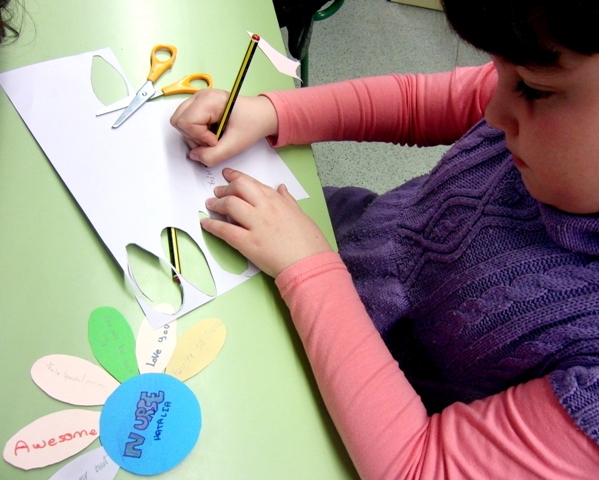 You can start by leading a group discussion on different jobs…have the students discuss things like what jobs their parents have and what they think they want to be when they grow up.


 Play the video again without sound. Give ten minutes to groups to come up with a narrative for the video clip. While students are writing, walk around and assist as necessary. When the groups have completed their narratives, choose alternative groups to narrate the video clip while it is being played.